



















Crimson Desert Section
2026-03-30

We're excited to announce our MetaForge Crimson Desert section which includes:

Marathon Section
2026-02-26

With the Launch of the Marathon Server Slam, we've added a Marathon Section to MetaForge.

Your Raider Profile for ARC Raiders
2026-02-24

Analyse your Raider statistics and round history with our new Raider profile. Sync and track all player stats, inventory, workshop, projects, quests and blueprints.

You need to be logged in to see your favorites.

Tallshroom Small

Add to Favorites
Tallshroom Small

Tallshroom Small Resource

Cuttable Flora

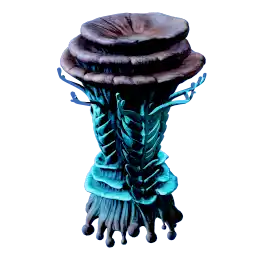
*Hyphen tallshroom*. A mysterious, chitinous life form with no clear terrestrial analog. 1. Hyphen Hyphens are colonies of hard-shelled hecaspids: shell-making algae. (Algae on this world descended from a star-like 'solarian' cell, while all animal life descended from an elongated 'polarian' cell.) Hecaspids in the colony align their shells into a column, forming tough armored threads, or hyphae. On Earth hyphae are characteristic of fungi, but it is not clear if an analogous group exists on this world. 2. Tallshroom The tallshroom is a complex organism with differentiated organs, but all its structures are fundamentally threadlike — hyphenated — and constructed of tough biopolymer akin to chitin. Gill-like structures along the flanks collect oxygen and chemistry from the water, fruiting bodies disperse reproductive cells, and the central body forms a sealed 'wellhead'. 3. Armored driller Tallshrooms drill their hyphae into the rock below, cracking open their own hydrothermal vents. The body captures the outflow of this vent, where bacteria convert minerals into energy. If the outflow becomes too hot or rapid, the tallshroom's drumlike top blows open, releasing the catastrophic overflow. 4. Viral history Like the mammalian placenta, the tallshroom's hyphae evolved in an explosion of retroviral inserts. These viral proteins are expressed in the tips of the drill fibers. Hyphae may have originally evolved as viral predators—inserting a symbiotic virus into armored life forms by growing on and cracking through their bodies. 5. Cousins Despite millions of years of evolutionary separation, the tallshroom shares elements of its body plan with the false fission drum *Polymephycite tympanum*, a fellow member of clade Scyllidae. It is unknown whether this represents convergent evolution, mimicry, or a viral gene transfer. Assessment: indicator of new evolutionary pathways unique to this world.

Unknown
Organic

Databank Entry for Tallshroom Small

*Hyphen tallshroom*. A mysterious, chitinous life form with no clear terrestrial analog. 1. Hyphen Hyphens are colonies of hard-shelled hecaspids: shell-making algae. (Algae on this world descended from a star-like 'solarian' cell, while all animal life descended from an elongated 'polarian' cell.) Hecaspids in the colony align their shells into a column, forming tough armored threads, or hyphae. On Earth hyphae are characteristic of fungi, but it is not clear if an analogous group exists on this world. 2. Tallshroom The tallshroom is a complex organism with differentiated organs, but all its structures are fundamentally threadlike — hyphenated — and constructed of tough biopolymer akin to chitin. Gill-like structures along the flanks collect oxygen and chemistry from the water, fruiting bodies disperse reproductive cells, and the central body forms a sealed 'wellhead'. 3. Armored driller Tallshrooms drill their hyphae into the rock below, cracking open their own hydrothermal vents. The body captures the outflow of this vent, where bacteria convert minerals into energy. If the outflow becomes too hot or rapid, the tallshroom's drumlike top blows open, releasing the catastrophic overflow. 4. Viral history Like the mammalian placenta, the tallshroom's hyphae evolved in an explosion of retroviral inserts. These viral proteins are expressed in the tips of the drill fibers. Hyphae may have originally evolved as viral predators—inserting a symbiotic virus into armored life forms by growing on and cracking through their bodies. 5. Cousins Despite millions of years of evolutionary separation, the tallshroom shares elements of its body plan with the false fission drum *Polymephycite tympanum*, a fellow member of clade Scyllidae. It is unknown whether this represents convergent evolution, mimicry, or a viral gene transfer. Assessment: indicator of new evolutionary pathways unique to this world.
© 2026 MetaForge - Guides, Databases and Tools for your favorite games: MMOs, ARPGs, Survival Games and more! All intellectual property and assets related to these games themselves are reserved by their respective owners.