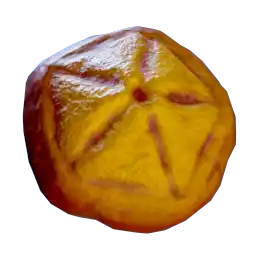
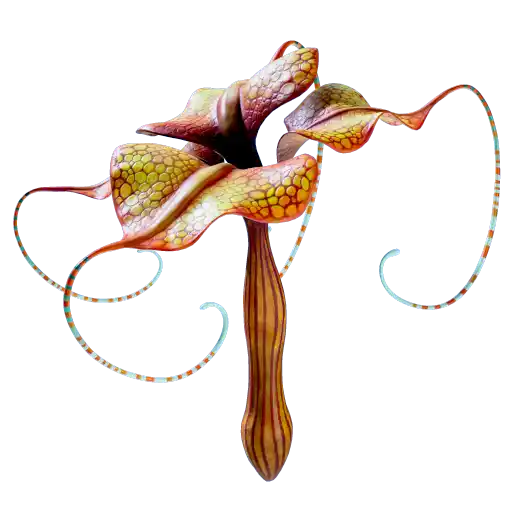
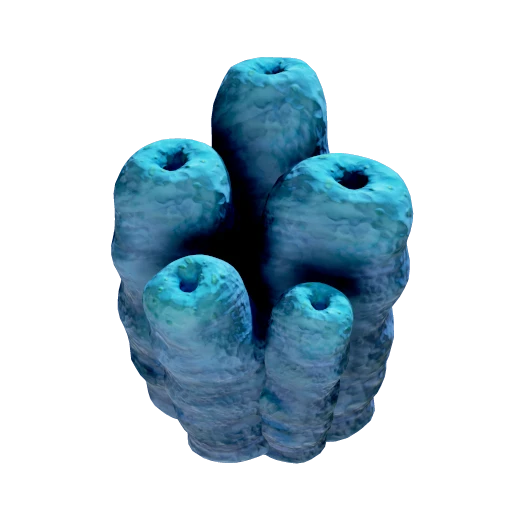
| Pent | Resources | Anomaly. No genes detected. Waxy shell full of sulfuric acid. |
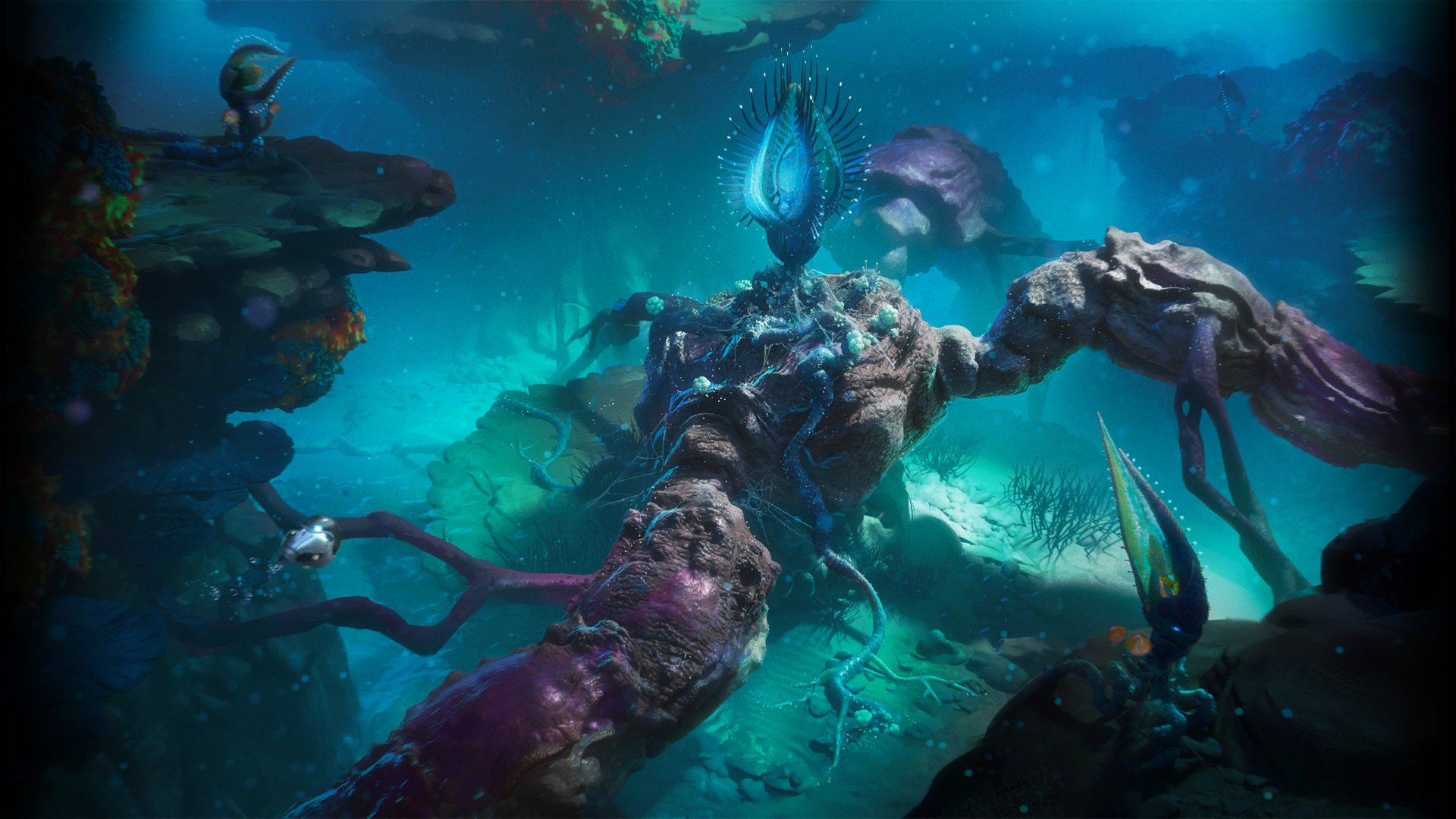
| Periscopic Clowncrab | Creatures | *Ostrakonskelos periskopion*, the hard-legged periscope. A social crab that shelters among stinging anemones.
1. Reduced body
The clowncrab's single-segment body is an illusion. The multiple segments of other Protean arthropods are still present, nested inside. When the clowncrab molts, it sheds its internal shells through its digestive tract.
2. Regenerative eyestalk
Enormous eyestalks mimic the surrounding anemones. If bitten off by a predator, each stalk is packed with unspecialized cells that quickly regenerate missing eyes. If the stalks grow too long, the clowncrab will trim them to avoid drawing attention.
3. Anemone tender
The clowncrab provides a valuable service to sessile anemones by ranging out to forage, returning nutrients in its molt and waste. It also grooms the anemones to clean parasites and infections.
4. Fecund stalk
The third stalk behind the eyes is a reproductive organ. The same unspecialized cells used to heal the eyestalks become eggs or sperm. Sperm is released into the seawater, while eggs are deposited among anemones.
Assessment: sign of a healthy anemone field.
*Caught script hook in allocated memory for command >> generate-databank "Clowncrab" >> echo
\memory-carve -signature=0xSEABEEF5 >> restore-remarks*
Remark A. Centipede!
I think the PDA got this thing's anatomy and reproduction completely wrong. I swear I've seen centipedes — a bunch of clowncrabs linked up in a train. I think they grow as a single, segmented organism and then each segment splits off into its own crab. And then maybe they hook up again later? It wouldn't be the weirdest thing we've seen. [metadata author=K. "Wander" Wangmo] |
| Photovoltaic Charger | General | Charges the Tadpole's power cell in shallow waters during the day. |
| Pioneer Hull Plate | Resources | — |
| Pioneer Program Poster | Base Building | Decorative Poster |
| Plankton Breathing | Bio Lab | You can breathe plankton (present in water currentrs). |
| Plant Based | Bio Lab | Consume plant matter for food and water |
| Plant Bulb | Organic | — |
| Plant Feeler | Organic | — |
| Plasteel Ingot | Resources | Bonelike matrix of titanium and ceramic. Self-healing. Stronger than strong. |
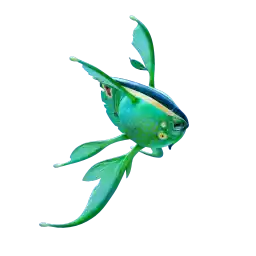
| Pneuma | Creatures | A prey fish that mimics the bladders of an undiscovered kelp species. |
| Pneuma | Bio Lab | — |
| Pneumo | Creatures | *Caught script hook in allocated memory for command >> generate-databank "Pneuma" >> echo
\memory-carve -signature=0xSEABEEF5 >> restore-databank*
"The pneuma is one of the ecological amputees we keep finding. It evolved for a niche that no longer exists. It found new ways to get things done, but I think it's still trying to grip that phantom hand." - Sophie Boucher, *Proteus As Patient*
*Pneuma pneuma*, a prey fish that mimics the bladders of kelp.
1. Fish
A relative of the halfmoon (Moliform luna). The paired pectoral, pelvic and anal fins are large but closely spaced, favoring agility over speed. The tail fin is ragged. All the fins mimic the pattern of kelp blades. The spinal nerve braid is protected by an armored stem similar to a kelp stipe. The jaw is a clamp; food is rasped by the tongue.
2. Kelp mimicry
The pneuma has evolved to mimic the air bladders of large kelp. It is unclear whether the pneuma traveled here from a kelp forest, or if a kelp forest in the Karakorum region went extinct.
3. Pneuma
The pneuma is named for its large swim bladder. When clamped to kelp with its beak, the pneuma's bladder pulls it upward, helping to support the kelp and maintain the pneuma's camouflage. Since there is no kelp in the Karakorum regions, pneuma have instead begun to swallow rocks to use as ballast.
Assessment: edible prey fish. Sign of ecological turmoil. Check for rocky ballast before consuming. |
| Poison tube cluster | Organic | Databank entry coming soon. |
| Political Consciousness | Resources | A quartz memory chip produced by an unlicensed fabricator recipe. |
| Portable Locker | Personal | Carryable, deployable storage. Does not change swim speed. |
| Portable Oxygen Generator | Personal | Produces oxygen over time through electrolysis. Requires battery to function.
|
| Power Cell | Consumables | High-capacity mobile power source. For large structures or vehicles. |
| Power Cell Terminal | Consumables | Recharges power cells. |
| Power Plant Part A | Base Building | — |
| Power Storage | Base Building | Harness excess power for later use. |
| Power Transmitter | Base Building | Extends the range of a power source. Exploits the Tamura-Murai process to transmit high-frequency current through ionized seawater |
| Powerful Kicks | Bio Lab | Swim faster for a short period after submerging |
| Powerful Kicks - Cave Variant | Bio Lab | Swim faster for a short period after getting oxygen from an Oxygen Plant |
| Powerful Kicks - Temperature Variant | Bio Lab | Swim faster in extreme temperature |
| Predator Sense | Bio Lab | Detect nearby threats with specialized hair cells |
| Pressurized Lungs | Bio Lab | You are immune to breathing penalties encountered below 100m. |
| PrintString | Bio Lab | Ability prints a string |
| Prismatic Shell | Organic | — |
| Processor | Base Building | Completes complex biochemical and manufacturing tasks over time for more advanced recipes. |
| Protected Zone Base Camp | Investigations | Small habitat built to support colonist expeditions into this region.
-Contains a functioning fabricator
-On-site NoA node could be reactivated for data retrieval
-Signs of recent visitation
May provide a useful jumping-off point for constructing a regional base of operations. |
| Pseudo Gills | Bio Lab | Dash restores a small amount of oxygen. |
| Pudding Urchin | Sustenance | An unlikely lifeform whose entire body plan resembles and indeed, tastes like, custard. Can be "cooked" in a fabricator to maximize nutrition. |
| Quadrate | Creatures | *Salpapod tetragnatha*. Similar behavior to Earth lamprey or hagfish. A risky eat. |
| Quaker | Investigations | Colony ethicist Lucretia Kapoor drowned when her bunkroom flooded.
-NoA opened the seacocks to flood the habitat and control a fire
-Colonists were drowned before they could reach their air supplies
-Biobeds were destroyed in the fire, preventing colonists from reprinting
Further investigation required. Recommend searching the surrounding habitat and its NoA node for more information. |
| Quartz | Resources | Silicon dioxide (SiO4). For silica glass and optical memory. Often makes up most of a planet's crust. |
| Quartz Node | Nodes | Coral domes expel waste silica as they grow. Check the surface and interior of coral domes.
In areas where domes do not grow, quartz may be located in sandy areas. |
| Quartz With Base | Nodes | — |
| Radio | Base Building | Wireless transmitter and receiver. Blocked by water. |
| Raw Ore | Resources | Rock debris with trace elements. |
| Reaper Leviathan | Base Building | — |
| Rebreather | Personal | Conserves oxygen when diving deeper. Automatically adjusts gas pressure to help lungs inflate. |
| Rectangular Ceiling Light | Base Building | A practical light for enhancing a pioneer's workspace. |
| Regeneration | Bio Lab | If damaged you heal 15 health every 15 seconds. |
| Regenerative Breath | Bio Lab | You regenerate some health whenever you consume oxygen. |
| Repair Tool | Personal | Combination scanner and portable fabricator. Repair vehicles, bases, and systems. |
| Research: Acid | Research | NEED:
1 SCAN ORGANIC ACID SOURCE
ACID SACS CAN BE REMOVED FROM ACID RAIONS WITH SURVIVAL MULTITOOL
ACID RAIONS PREFER SHADY AREAS AND CAVES — COLDER WATER CONTAINS MORE PREY
LOGGING RESULTS TO PDA DATABANK |
| Research: Gold | Research | I NEED: 1 SCAN GOLD DEPOSIT
GOLD PRECIPITATES FROM HIGH-TEMPERATURE MINERAL-RICH WATER
CHECK DEEP, HOT CAVES TO THE EAST
LOGGING RESULTS TO PDA DATABANK |
| Research: Lifepod surroundings | Research | GENERATING NAME - "CORAL GARDENS"
NEED:
SCAN PRIMARY PRODUCERS (FEED ON SUNLIGHT)
SCAN FILTER FEEDERS (FEED ON SEAWATER)
SCAN STING FEEDERS (FEED ON PLANKTON)
SCAN FORAGERS (FEED ON CORALS/SPONGES/SMALL PREY)
SCAN PREDATOR (FEED ON FORAGERS)
SCAN DETRITIVORE (FEED ON DEAD MATTER) |
| Research: Quartz | Research | I NEED: 1 SCAN QUARTZ CRYSTAL
CORAL DOMES EXPEL WASTE SILICA
CHECK DOME SURFACE AND INTERIOR FOR QUARTZ CRYSTALS
LOGGING RESULTS TO PDA DATABANK |